Introduction: The Translation That Changed the Christ
If you’ve ever spoken with a Jehovah’s Witness, you’ve likely encountered the New World Translation of the Holy Scriptures (NWT) — the Watchtower Society’s own translation of the Bible. It’s not merely a different English rendering; it’s a theological project. Nowhere is this more evident than in how it handles passages about Jesus’ identity.
The NWT consistently downplays Christ’s deity, most famously in John 1:1, where “the Word was God” becomes “the Word was a god.” Yet here’s the irony: even with its doctrinally driven alterations, the NWT still contains enough unaltered Scripture to overturn the very theology it seeks to defend.
To any Jehovah’s Witnesses reading this: I urge you to open your own copy of the New World Translation and follow along. Don’t take my word for it — see with your own eyes what your Bible says.
What follows is a guided walk through key NWT passages which, when read in context, leave no room for doubt: the New Testament presents Jesus not as a lesser divine being, but as fully sharing in the identity of Jehovah.
John 1:1 — The Word Was God
“In [the] beginning the Word was, and the Word was with God, and the Word was a god.”
– John 1:1 New World Translation
The NWT’s “a god” translation is rejected by virtually every Greek scholar of note.
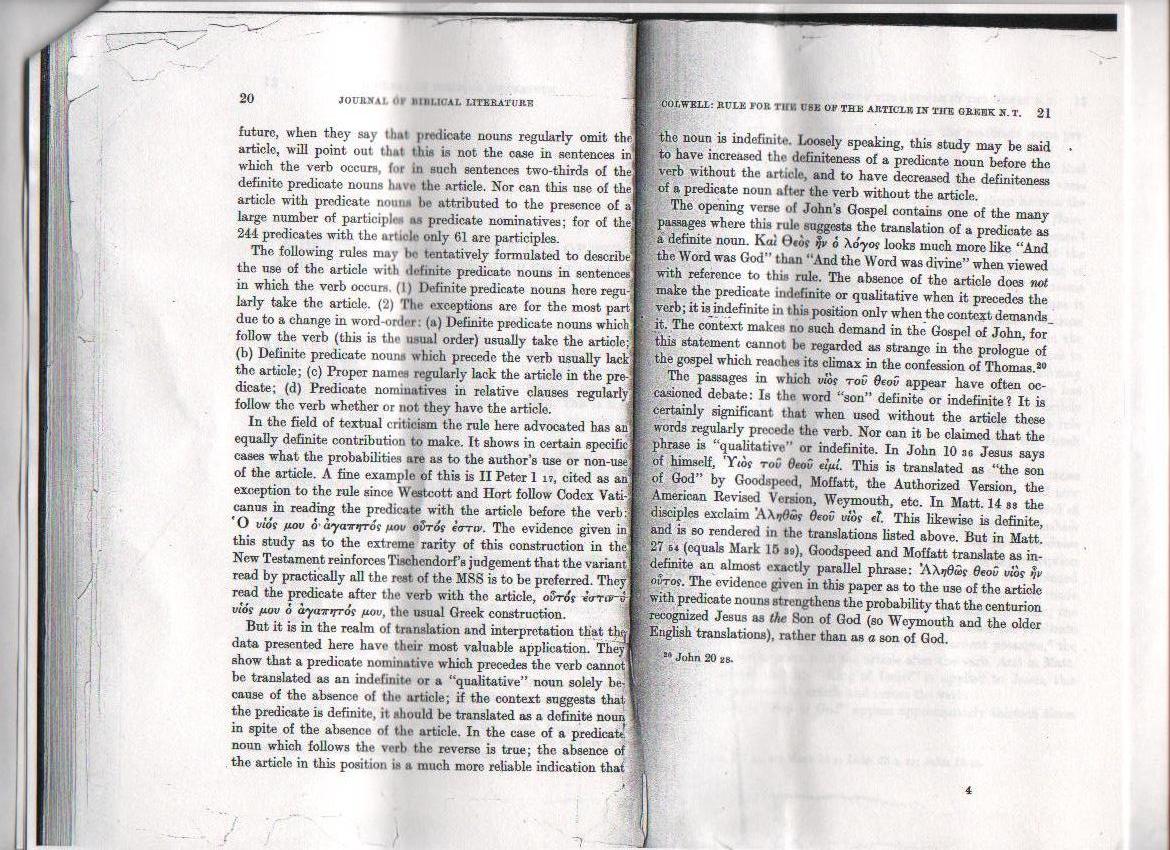
E.C. Colwell demonstrated that a predicate noun preceding the verb without the article is typically qualitative, not indefinite. (A Definite Rule for the Use of the Article in the Greek New Testament, pp. 20-21) (1)
Philip B. Harner concluded the clause means “the Word had the same nature as God.” (Qualitative Anarthrous Predicate Nouns: Mark 15:39 and John 1:1, p. 87) (2)
Bruce Metzger called the NWT rendering “a frightful mistranslation” (The Jehovah’s Witnesses and Jesus Christ, p. 75) (3)
Julius R. Mantey publicly objected to the Watchtower’s misuse of his grammar, calling their rendering “neither scholarly nor reasonable.” (Letter to the Watchtower Bible and Tract Society, Jully 11, 1974, p. 1) (4)
Even the NWT’s own Kingdom Interlinear betrays the problem: the Greek simply says the Word was God (theos ēn ho logos). (5) The grammar doesn’t allow for “a god” without importing a theology foreign to John’s prologue.
But the theological implications go deeper than grammar. When this rendering of John 1:1 is combined with the Watchtower’s treatment of Hebrews — where Jesus is described as a created being, a chief angel elevated to functional godhood — the result is a system that effectively splits divinity. Jehovah becomes the supreme High God, while Jesus is a subordinate divine figure, distinct in being and eternally lesser in rank. He is worshiped, enthroned, and called “a god,” yet remains ontologically separate from Jehovah.
This framework amounts to a form of functional polytheism. It introduces two divine beings — one supreme, one subordinate — who share glory, receive worship, and rule together, yet are not one in essence. This undermines the monotheistic clarity of Scripture, which repeatedly affirms that Yahweh (Jehovah) alone is God, and that no other shares His divine nature (Isaiah 43:10; 44:6; 45:5, etc.).
By contrast, Trinitarian theology preserves monotheism by affirming that the Father, Son, and Spirit are one God in three persons — coequal, coeternal, and consubstantial. It does not elevate a creature to divinity, but recognizes that the Son is divine by nature, not by appointment.
Hebrews 1 and Psalm 102 — The Creator Identified
In Hebrews 1:10–12, the writer quotes Psalm 102:25–27 — a psalm addressed to Jehovah — and applies it directly to the Son.
If you read Psalm 102 in the NWT, the speaker is clearly addressing Jehovah from the very first verse:
“O Jehovah, hear my prayer…” (Ps. 102:1, NWT)
Through the psalm, the “you” being addressed is consistently Jehovah. In verses 25–27 (NWT), the psalmist says:
“Long ago you laid the foundations of the earth,
And the heavens are the work of your hands.
They will perish, but you will remain;
Just like a garment they will all wear out.
Just like clothing you will replace them, and they will pass away.
But you are the same, and your years will never end.”
There is no change of subject in the psalm — these words are spoken to Jehovah.
Likewise, in Hebrews 1, the writer is making a sustained argument for the supremacy of the Son over angels. However, unlike Psalm 102, which records a human speaking to Jehovah, Hebrews 1:10-12 places the words of the Psalmist into Jehovah’s mouth. Put another way, what the Psalmist says of Jehovah, Jehovah says of the Son. We see this made explicitly clear in verse 8:
“But about the Son, he (Jehovah) says…” (Heb. 1:8, NWT)
The next quotation — verses 10–12 — is introduced without changing the subject. In the NWT, it reads:
“And: ‘You, O Lord, laid the foundations of the earth in the beginning,
and the heavens are the works of your hands.
They will perish, but you will remain;
and just like a garment, they will all wear out,
and you will wrap them up just as a cloak, as a garment, and they will be changed.
But you are the same, and your years will never come to an end.’” (Heb. 1:10–12, NWT)
The “You, O Lord” here is still the Son — the same subject from verse 8 — and the words spoken by Jehovah Himself are a direct quotation of Psalm 102:25–27.
“You, O Lord, laid the foundations of the earth…”
As Thomas E. Gaston notes, this is a deliberate identification of Jesus with the God of Israel, not a casual proof-text. (Why Does Hebrews 1:10–12 Cite Psalm 102:25–27?, p. 292) (6)
The Everlasting Light — Isaiah 60 and Revelation 21
Isaiah 60:19–20 (NWT) says:
“For you the sun will no longer be a light by day, nor will the shining of the moon give you light, For Jehovah will become to you an eternal light, and your God will be your beauty. No more will your sun set, nor will your moon wane, For Jehovah will become for you an eternal light, And the days of your mourning will have ended.”
Key points to draw out:
Revelation 21:22–24 (NWT) says:
“I did not see a temple in it, for Jehovah God the Almighty is its temple, also the Lamb is. And the city has no need of the sun or the moon to shine on it, for the glory of God illuminated it, and its lamp was the Lamb. And the nations will walk by means of its light…”
Key points to draw out:
The parallel with Isaiah is too exact to be accidental: both scenes describe the same eternal state, both replace sun and moon with divine light, and both identify the light with a single personal being — in Isaiah, Jehovah; in Revelation, the Lamb.
We also find additional support for this from a number of other verses in the NWT.
The same role, the same glory, the same eschatological function — and in Isaiah, that role belongs to Jehovah alone. (7)
The Sanctuary of God — Ezekiel 37 and Revelation 21
Ezekiel 37:26–28 (NWT) says:
“I will make a covenant of peace with them; it will be an eternal covenant with them. I will establish them and make them many and place my sanctuary among them forever. My tent will be with them, and I will be their God, and they will be my people. And the nations will have to know that I, Jehovah, am sanctifying Israel when my sanctuary is in their midst forever.”
Key points to draw out:
Revelation 21:22 (NWT) says:
“I did not see a temple in it, for Jehovah God the Almighty is its temple, also the Lamb is.”
Key points to draw out:
We also find additional support from additional passages in the NWT as before:
The Lamb shares in Jehovah’s exclusive dwelling presence — something no created being could do without blasphemy. (8)
Creator of All Things — Colossians 1:15–17
The NWT inserts “other” four times (“all other things”) to avoid the implication that Jesus created everything. But NWT’s own Kingdom Interlinear shows the Greek τὰ πάντα (ta panta)—“all things”—with no “other” present. This is the correct translation of ta panta and it is actually rendered as such in passages like Ephesians 1:10 in the NWT. (9)
As Daniel B. Wallace observes, the insertion of “other” in Colossians 1:15-17 is a doctrinally motivated, deliberate attempt to obscure the meaning of Scripture from the reader, and is inconsistent with the NWT’s own translation choices elsewhere. (Greek Grammar Beyond the Basics, p. 267) (10)
Alpha and Omega — Revelation 1 and 22
Revelation 1:8 (NWT) says:
“‘I am the Alʹpha and the O·meʹga,’ says Jehovah God, ‘the One who is and who was and who is coming, the Almighty.’”
Key points to draw out:
Revelation 22:12–16 (NWT) says in part:
“Look! I am coming quickly, and the reward I give is with me, to repay each one according to his work. I am the Alʹpha and the O·meʹga, the first and the last, the beginning and the end… ‘I, Jesus, sent my angel to bear witness to you about these things for the congregations. ...’”
Key points to draw out:
The speaker says, “I am coming quickly” — a phrase used throughout Revelation for Christ’s return (e.g., Rev 3:11, NWT).
Just a few verses later, the same speaker says, “I, Jesus, sent my angel…” — directly identifying himself as Jesus.
Once more, we have additional corroboration from other passages in the New World Translation:
The title denotes eternal sovereignty over all history. The NWT applies it to both Jehovah and Jesus — collapsing the supposed ontological gap. (11)
The Glory Jehovah Will Not Share
Isaiah 42:8 (NWT)
“I am Jehovah. That is my name; I give my glory to no one else, nor my praise to graven images.”
Isaiah 48:11 (NWT)
“…And I will not give my glory to anyone else.”
John 17:5 (NWT)
“So now, Father, glorify me (Jesus) at your side with the glory that I had alongside you before the world was.”
Revelation 5:12–13 (NWT)
“…to the One sitting on the throne and to the Lamb be the blessing and the honor and the glory and the might forever and ever.”
Key points to draw out:
Once again, Scripture collapses the ontological distinction between Jehovah and the Son. Jehovah does not share His glory with another, yet He does so with the Son.
Jehovah's Angel is Jehovah in Exodus 3
Exodus 3:1–15 (NWT)
“Jehovah’s angel appeared to him in a flame of fire in the midst of a thornbush. As he kept looking, why, here the thornbush was burning with the fire and yet the thornbush was not consumed.
“When Jehovah saw that he turned aside to look, God called to him out of the midst of the thornbush and said: ‘Moses! Moses!’ to which he said: ‘Here I am.’
“Then he said: ‘Do not come near here. Remove your sandals from your feet, because the place where you are standing is holy ground.’
“And he went on to say: ‘I am the God of your father, the God of Abraham, the God of Isaac, and the God of Jacob.’ Then Moses hid his face, because he was afraid to look at the true God.
“Jehovah added: ‘I have certainly seen the affliction of my people who are in Egypt, and I have heard their outcry because of their oppressors, for I well know the pains they suffer.
“I will go down to rescue them out of the hand of the Egyptians and to bring them up out of that land to a good and spacious land, a land flowing with milk and honey…’
“At this God said to Moses: ‘I Will Become What I Choose to Become.’ And he added: ‘This is what you are to say to the Israelites, ‘I Will Become has sent me to you.’
“Then God said once more to Moses: ‘This is what you are to say to the Israelites, ‘Jehovah, the God of your forefathers, the God of Abraham, the God of Isaac, and the God of Jacob, has sent me to you.’ This is my name forever, and this is how I am to be remembered from generation to generation.’”
So, here in Exodus, we clearly see in the NWT that Jehovah’s angel is identified with and speaks as Jehovah Himself. This is not something we would see if this person were a lesser created being.
Key points to draw out:
Verse 6 — The voice speaking from within the burning bush declares: “I am the God of your father, the God of Abraham, the God of Isaac, and the God of Jacob.”
Verses 7–15 — The speaker continues as Jehovah and God, commissioning Moses and revealing the divine name (rendered “I Will Become What I chose to Become in the NWT or “I Am” in most other translations — “I Am” being a title Jesus used of himself on numerous occasions, e.g., John 8:24, 28, 58; 13:19, 18:5-6; Mark 14:61-62, etc.).
The Angel of God and Jehovah’s Presence in Exodus 13–14
Exodus 13:21–22; 14:19–20
“Jehovah was going ahead of them by day in a pillar of cloud to lead them along the way, and by night in a pillar of fire to give them light, so that they could travel by day and by night. The pillar of cloud by day and the pillar of fire by night never left its place in front of the people.”
“Then the angel of the true God who was going ahead of the camp of Israel departed and went to their rear, and the pillar of cloud moved from in front of them and stood behind them. So it came between the camp of the Egyptians and the camp of Israel. On the one side it was a cloud and darkness; on the other side it was lighting up the night. So the one camp did not come near the other all night long.”
Here, as in Exodus 3, the narrative presents a striking overlap between Jehovah Himself and His angel. In 13:21, it is Jehovah who is personally going ahead of Israel in the pillar of cloud and fire. Yet in 14:19, the one moving is “the angel of the true God” — and the pillar moves with him. The text does not treat these as two separate presences; rather, the angel’s movement and Jehovah’s movement are described as one coordinated act.
This is consistent with other “blended identity” passages where the malʾakh YHWH (angel of Jehovah) is both distinct from and yet fully identified with God, speaking and acting as His very presence.
Key points to draw out:
Just as in the other passages we’ve discussed, the line between Jehovah and His angel is intentionally blurred. The angel is not portrayed as a mere created messenger operating independently, but as the embodiment of Jehovah’s own presence — guiding, protecting, and delivering His people. The narrative’s seamless shift between “Jehovah” and “the angel of the true God” underscores the theological reality that to encounter this angel is to encounter Jehovah Himself.Misunderstanding “Angel”: A Linguistic Clarification
Jehovah’s Witnesses often assume that the word “angel” refers exclusively to supernatural beings. But in the Old Testament, the Hebrew word translated “angel” is מַלְאָך (malak) — meaning simply “messenger.” It is a job description, not a category of created beings. In fact, the exact same word is frequently used to describe human beings (e.g., 2 Samuel 5:11; Malachi 2:7; Haggai 1:13, etc.). The context determines whether the messenger is human or divine — not the word itself. Additionally, the presence of the definite article (“the malak of Jehovah”) often signals a unique, divine figure — not a generic angelic being.
This linguistic nuance is crucial. The NWT’s rigid interpretation of “angel” as a lower ontological category of divine beings exclusively leads to theological error. The Angel of Jehovah is not merely a messenger from God — he is consistently identified by Scripture as God’s own self-revelation, speaking, acting, and receiving worship as Jehovah.
The Angel of Jehovah: Seen, Worshiped, and Named as God
Judges 13: A Theophany in Disguise
In Judges 13:1–23, the New World Translation recounts the story of Samson’s parents encountering “Jehovah’s angel.” The passage builds toward a climactic theological moment, especially in verses 13–22:
“So Jehovah’s angel said to Ma·noʹah: ‘Your wife should keep herself from everything that I mentioned to her. She should not eat anything that the grapevine produces, she should not drink wine or anything alcoholic, and she should not eat anything unclean. Everything that I commanded her, let her observe.’
“Ma·noʹah now said to Jehovah’s angel: ‘Please stay, and let us prepare a young goat for you.’
“But Jehovah’s angel said to Ma·noʹah: ‘If I stay, I will not eat your food; but if you wish to present a burnt offering to Jehovah, you may offer it up.’ (Ma·noʹah did not know that he was Jehovah’s angel.)
“Then Ma·noʹah said to Jehovah’s angel: ‘What is your name, so that we may honor you when your words come true?’
“However, Jehovah’s angel said to him: ‘Why do you ask about my name, when it is a wonderful one?’
“So Ma·noʹah took the young goat and the grain offering and offered it on the rock to Jehovah. And He was doing something amazing while Ma·noʹah and his wife were watching.
“When the flame ascended from the altar toward the heavens, Jehovah’s angel ascended in the flame of the altar while Ma·noʹah and his wife were watching, and they immediately fell with their faces to the ground.
“Jehovah’s angel did not appear again to Ma·noʹah and his wife. Then Ma·noʹah realized that it had been Jehovah’s angel. Ma·noʹah then said to his wife: ‘We will surely die, because it is God we have seen.’”
Key points to draw out:
Despite the NWT’s attempt to distinguish “Jehovah’s angel” from Jehovah Himself, the narrative collapses that distinction. Manoah’s conclusion is unmistakable: they have seen God–capitol G. Not merely “a god” as in the NWT version of John 1:1. Nor was this a created messenger. It was God. This echoes Judges 6:11–24, where Jehovah's angel is unmistakably identified as Jehovah Himself (verses 14–16). The encounter leaves Gideon terrified, crying out, “Alas, Sovereign Lord Jehovah! I have seen Jehovah’s angel face-to-face!” — a reaction reserved for those who realize they’ve stood in the presence of God.
Worship and Divine Identity
Throughout the Hebrew Bible, the Angel of Jehovah:
These are not attributes of a created being. As Edward Dalcour notes, “The angel of the Lord in the OT was not a mere ‘created’ angel… He was identified as, and claimed to be, YHWH.” (The Preincarnate Christ as the “Angel of the LORD” (YHWH), para. 2) (13)
Jehovah Commands His Angels to Worship the Son in Hebrews 1:6