Translate

Showing posts with label The Death of Jesus. Show all posts

Saturday, July 18, 2026

Was Genesis 3:21 the First Sacrifice?


Introduction

The belief that Genesis 3:21 marks the first animal sacrifice is a widely held interpretation in some theological circles. However, a close reading of the text reveals that this claim is an inference rather than an explicit statement. While the passage mentions "garments of skin" provided by God to Adam and Eve, it does not specify how they were obtained or suggest a sacrificial act tied to atonement. Genesis, unlike later biblical texts that introduce structured sacrificial systems, does not establish animal sacrifice as a divine mandate for sin. This article critically examines the textual and theological basis for this interpretation, exploring the lack of explicit sacrificial language in Genesis and the significance of the narrator’s commentary on Eve’s naming in Genesis 3:20, particularly in contrast with the absence of similar commentary regarding the garments of skin.

Genesis 3:21: Interpretation vs. Explicit Statement

Genesis 3:21 states: "The Lord God made clothing from skins for the man and his wife, and he clothed them." The text does not specify how these skins were obtained, nor does it indicate that an animal was sacrificed as a substitutionary atonement for Adam and Eve’s sin. Some scholars argue that the skins imply an animal’s death, but this is an assumption rather than a direct statement from the text.

Commentaries on Genesis 3:21 highlight differing perspectives. Some scholars suggest that the skins were obtained through sacrifice, possibly foreshadowing later atonement practices. (1) Others argue that the passage simply describes God’s provision for Adam and Eve without implying a theological precedent for sacrifice. (2)

Cain and Abel’s Offerings: Not Sin Offerings

Genesis 4:3-5 describes the offerings of Cain and Abel: "In the course of time Cain presented some of the land’s produce as an offering to the Lord. And Abel also presented an offering—some of the firstborn of his flock and their fat portions. The Lord had regard for Abel and his offering, but he did not have regard for Cain and his offering."

The text does not describe Abel’s offering as a sin offering. Instead, it is simply an offering, possibly a gift of gratitude or devotion. Later biblical texts distinguish between various types of sacrifices—sin offerings, burnt offerings, and thanksgiving offerings—but Genesis does not provide such distinctions. Some Jewish commentaries suggest that Cain’s offering was rejected due to its inferior quality rather than because it lacked blood sacrifice. (3) Others propose that Cain’s offering was rejected due to his attitude rather than the nature of the offering itself. (4)

Noah’s Offering: A Free-Will Sacrifice, Not Atonement for Sin

After the flood, Noah builds an altar and presents burnt offerings to God. Genesis 8:20-21 states: "Then Noah built an altar to the Lord. He took some of every kind of clean animal and every kind of clean bird and offered burnt offerings on the altar. When the Lord smelled the pleasing aroma, he said to himself, 'I will never again curse the ground because of human beings, even though the inclination of the human heart is evil from youth onward. And I will never again strike down every living thing as I have done.'"

Unlike later sacrificial systems, Noah’s offering is not explicitly connected to sin or atonement. Instead, it functions as an act of worship, gratitude, and covenantal recognition. The text describes the offering as a "pleasing aroma" to God, leading to His promise never to destroy the earth by flood again. The absence of language linking Noah’s burnt offerings to sin supports the argument that Genesis does not present a formalized system of sacrificial atonement. Scholars such as John Walton argue that Noah’s sacrifice is primarily a dedicatory act rather than a ritual of purification or substitution.

Abraham’s Sacrifices: Monuments, Covenant Rituals and a Test of Faith

Abraham’s sacrificial practices appear in multiple instances throughout Genesis, each serving a distinct purpose. Throughout his journey, Abram builds altars to worship God, marking moments of divine encounter and covenant affirmation (Genesis 12:7, 13:3-4, 13:18). Unlike later sacrificial systems prescribed for atonement, these altars serve as places of devotion and acknowledgment of God’s promises. His covenant sacrifices in Genesis 15 establish a formal agreement between God and Abraham, while his near-sacrifice of Isaac in Genesis 22 functions as a test of faith rather than an atonement offering.

The Covenant Sacrifices (Genesis 15:9-10, 17-18)

In Genesis 15, God establishes a covenant with Abraham, promising him descendants and land. As part of this covenant, Abraham is instructed to prepare a sacrificial ritual. Genesis 15:9-10 states: "He said to him, 'Bring me a three-year-old cow, a three-year-old female goat, a three-year-old ram, a turtledove, and a young pigeon.' So he brought all these to him, cut them in half, and laid the pieces opposite each other, but he did not cut the birds in half."

Later, in Genesis 15:17-18, God symbolically passes between the pieces of the sacrifice: "When the sun had set and it was dark, a smoking fire pot and a flaming torch appeared and passed between the divided animals. On that day the Lord made a covenant with Abram, saying, 'I give this land to your offspring, from the Brook of Egypt to the great river, the Euphrates.'"

This ritual reflects an ancient Near Eastern practice in which parties making a covenant would walk between the divided animals, signifying the seriousness of the agreement. Unlike later sin offerings, this sacrifice is not about atonement but rather about sealing a divine promise. Scholars such as Gordon Wenham and John Walton note that this covenant ceremony emphasizes God’s unilateral commitment to fulfilling His promises to Abraham.

The Near-Sacrifice of Isaac (Genesis 22:1-13)

One of the most well-known sacrificial accounts in Genesis is Abraham’s near-sacrifice of Isaac. Genesis 22:1-2 states: "After these things God tested Abraham and said to him, 'Abraham!' 'Here I am,' he answered. 'Take your son,' he said, 'your only son Isaac, whom you love, go to the land of Moriah, and offer him there as a burnt offering on one of the mountains I will tell you about.'"

However, as the narrative unfolds, Abraham does not sacrifice Isaac. Instead, God provides a ram as a substitute. Genesis 22:13 states: "Abraham looked up and saw a ram caught in the thicket by its horns. So, Abraham went and took the ram and offered it as a burnt offering in place of his son."

The passage presents Abraham’s willingness to sacrifice Isaac as a test of faith rather than a prescribed atonement offering. Unlike later sin offerings in biblical history, this episode emphasizes obedience and divine provision rather than ritualized purification. Scholars such as Gerhard von Rad and Walter Brueggemann argue that the substitution of the ram does not reflect the later concept of sin atonement but instead reinforces the idea that God provides for His people.

Jacob's Sacrifice: A Covenant Meal, Not Atonement for Sin

Jacob offers a sacrifice in the context of a covenant meal with his relatives, marking an agreement between himself and Laban. Genesis 31:54 states: "He offered a sacrifice there in the hill country and invited his relatives to a meal. After they had eaten, they spent the night there."

Unlike later prescribed sacrifices, this act is not an atonement ritual but rather a communal offering, potentially symbolizing peace and agreement. Ancient Near Eastern covenants often involved meals alongside sacrifices, signifying unity and resolution. Some scholars, including Victor Hamilton, note that this passage emphasizes the relational aspect of sacrifice rather than a theological system of sin atonement.

Israel's Sacrifice at Beersheba: Worship and Seeking Divine Guidance

Before traveling to Egypt, Jacob (Israel) pauses at Beersheba to offer sacrifices, an act that appears to express worship and a desire for divine approval. Genesis 46:1 states: "So Israel set out with all that he had and came to Beersheba, and he offered sacrifices to the God of his father Isaac."

This moment is significant, as Jacob is about to relocate his family to Egypt—a land unfamiliar to him but necessary for survival. Sacrificing at Beersheba connects him to his father’s legacy and may reflect a plea for reassurance. Walter Brueggemann suggests that this passage highlights the personal and relational nature of sacrifice rather than a mandated sin offering.

The Absence of a Command for Sin Offerings in Genesis

Throughout Genesis, there is no divine command for humans to sacrifice animals for sin. While sacrificial systems emerge later in biblical history, Genesis itself lacks prescribed offerings for atonement. Instead, the offerings mentioned in Genesis appear to be acts of worship or devotion rather than mandated rituals for sin.

The formalization of sacrificial practices is most clearly outlined in later biblical texts, particularly in Leviticus. (5) The absence of sin offerings in Genesis suggests that early sacrifices were voluntary expressions of worship rather than institutionalized atonement rituals.

Genesis 3:20: The Naming of Eve and the Lack of Commentary on Animal Skins

Genesis 3:20 states: "The man named his wife Eve because she was the mother of all the living." In this verse, the narrator of Genesis provides explicit commentary on Eve’s name, explaining its significance. However, in the next verse, Genesis 3:21, he does not provide any commentary linking the garments of skin to sacrifice or atonement.

This omission is significant. If the intent of Genesis 3:21 was to establish a precedent for sin offerings, it would be expected that the narrator would provide commentary to that effect, as is done elsewhere in Genesis when theological themes are introduced. The absence of such commentary suggests that the garments of skin were simply a provision for clothing rather than a theological statement about sacrifice.

Scholars note that Adam’s naming of Eve reflects a recognition of her role in humanity’s future, emphasizing life rather than judgment. (6) Some interpretations suggest that this act of naming was an expression of hope despite the consequences of sin. (7)

Conclusion: Rethinking Sacrifice in Genesis and the Fulfillment in Christ

The claim that Genesis 3:21 represents the first animal sacrifice is an interpretative tradition rather than an explicit statement from the text. While some traditions infer that an animal was killed to provide skins, the passage does not mention sacrifice, atonement, or substitutionary death. The absence of direct commentary linking the garments of skin to sacrifice—especially when contrasted with the explicit commentary on Eve’s naming in Genesis 3:20—reinforces the argument that Genesis does not introduce a system of sacrificial atonement. Instead, Genesis 3:21 reflects divine provision for Adam and Eve’s physical needs rather than a theological precedent for sin offerings.

Furthermore, an examination of other sacrifices in Genesis shows a consistent pattern: offerings serve as acts of worship, thanksgiving, or covenantal agreements rather than mandated rituals for atonement. Cain and Abel’s offerings in Genesis 4 demonstrate a distinction between acceptable and unacceptable worship, but they do not introduce a sin offering framework. Similarly, Noah’s burnt offerings after the flood (Genesis 8:20-21) are described as a "pleasing aroma" rather than a necessity for purification. Abraham’s covenant sacrifices in Genesis 15 establish a divine promise, and his near-sacrifice of Isaac (Genesis 22) is a test of faith rather than a prescribed atonement practice. Jacob’s sacrifice in Genesis 31 signifies a peace agreement, and Israel’s offering at Beersheba (Genesis 46) reflects worship and guidance-seeking.

Taken together, these accounts reveal that Genesis does not present a structured system of sacrifices for sin, nor does it include divine commands requiring atonement through animal offerings. It is only later in biblical history, particularly within the Mosaic Law, that sacrifices for sin, purification, and thanksgiving are formally prescribed.

However, even these sacrificial systems point forward to a greater fulfillment. The trajectory of sacrifice in Scripture culminates in Jesus Christ, who is described as the final and perfect sacrifice for sin. Hebrews 10:10 states: "By this will, we have been sanctified through the offering of the body of Jesus Christ once for all." While Genesis introduces the theme of sacrifice in various forms, it ultimately lays the groundwork for God’s redemptive plan, which finds completion in Christ. Unlike the temporary atonement provided by animal sacrifices in later biblical texts, Christ’s sacrifice is final, fully sufficient, and offered willingly for the redemption of humanity (John 1:29; Hebrews 9:12-14).

This analysis invites readers to reconsider traditional interpretations and approach Genesis with a careful distinction between textual statements and theological inferences. By recognizing that sacrificial practices in Genesis function as worship, covenantal rituals, and faith expressions rather than a systematic means of atonement, we gain a clearer understanding of how the theme of sacrifice develops throughout biblical history. More importantly, this trajectory ultimately leads to Christ—the fulfillment of all sacrifices—whose death provides the perfect and lasting atonement that no animal offering could achieve.




Saturday, June 27, 2026

Understanding the Biblical Fool: Why Atheism Isn’t the Target


Introduction


A common argument within certain Christian circles, particularly among Young Earth Creationists (YEC), is the claim that Scripture explicitly identifies atheists as fools. This perspective is exemplified by organizations such as Answers in Genesis:

"The Bible clearly identifies atheists as fools, and yet many Christians seem nervous to engage with atheists intellectually, and some are downright fearful of trying to make sense of their arguments against God." (1)

"For Christians looking for wisdom in responding to atheist arguments against God, Proverbs 26:4–5 gives clear direction into both how to and how not to answer their objections." (2)

However, a closer exegetical and historical analysis of the biblical passages often cited in these arguments suggests that Scripture is not singling out atheists in the modern sense. Instead, the term "fool" has a much broader meaning, referring to anyone who is morally deficient, spiritually blind, and living in rebellion against God.

The Meaning of "Fool" in Scripture

Atheism, as understood today—a structured philosophical rejection of God—was not a concept in the ancient Near East when biblical texts were written. The Hebrew term nabal (נָבָל) translated as "fool," denotes someone who lacks moral and spiritual wisdom, rather than someone who intellectually denies God's existence. This term characterizes a reckless, wicked, and senseless person who defies God's commandments rather than explicitly rejecting His existence.

Psalms 14, and 53—commonly cited in arguments labeling atheists as fools—do not target atheists exclusively. Instead, they describe the "fool" as someone who lives as though there is no divine accountability. This is further exemplified by Psalm 10, which states in verse 4:

"In all his scheming, the wicked person arrogantly thinks, 'There’s no accountability, since there’s no God.'"

Similarly, Psalms 14 and 53 depict this archetype as representative of all sinful humanity. The Apostle Paul reinforces this interpretation in Romans 3:9–12:

"None is righteous, no, not one; no one understands; no one seeks for God. All have turned aside; together they have become worthless; no one does good, not even one."

Here, Paul references Psalm 14 to indict all of humanity rather than singling out atheists, thereby undermining claims that these passages specifically condemn modern atheism.

The Dangers of Misapplying These Passages

Interpreting these verses as proof texts against atheism presents both theological and strategic challenges. While Scripture affirms humanity's fallen nature, initiating conversations with non-believers by labeling them as "fools" can create hostility rather than foster constructive dialogue. Answers in Genesis' interpretation suggests that Proverbs 26:4–5 provides direct guidance for responding to atheists, yet a closer examination reveals a more nuanced approach—one that focuses on discernment in engagement rather than outright dismissal or claims of intellectual superiority.

This cautionary perspective echoes St. Augustine of Hippo's warning in The Literal Meaning of Genesis (c. 415 AD), where he stresses that misrepresenting Scripture can harm evangelism. Augustine urged Christians to approach biblical interpretation with intellectual humility, warning that careless readings—especially those that contradict observable reality—could lead non-believers to dismiss not only the interpreter but Scripture itself. (3) His concern was not merely about theological accuracy but about the broader impact on Christian witness.

Despite Augustine's observations, many evangelicals and fundamentalists lack formal training in biblical languages, historical context, and theological development. This absence weakens their engagement with atheists, particularly when responding to criticisms based on textual misunderstandings. Additionally, critics often assume that all Christians adhere to a literalist framework, failing to recognize the broader intellectual tradition within Christianity (Augustine himself did not ascribe to the modern YEC interpretation, arguing instead that creation occurred instantaneously, with its development unfolding over time according to divine providence).

Conclusion: Toward a More Thoughtful Approach

A more effective apologetic strategy requires deeper study of Christian history, theology, and biblical scholarship. Christians should be unafraid to admit when they lack an immediate answer and should embrace research and engagement with differing perspectives. Many atheist objections arise from critiques of fundamentalist interpretations rather than Christianity itself, and recognizing this distinction can lead to more productive conversations.

Ultimately, equipping believers with intellectual humility and sound scholarship fosters meaningful discussions with skeptics. Thoughtful engagement—rather than reactionary rhetoric—presents the gospel in a manner that is both truthful and inviting, transforming dialogue into an opportunity for mutual understanding rather than ideological combat. By embracing the complexity of faith and doubt, believers can build bridges rather than barriers, creating space for deeper reflection, genuine inquiry, and the possibility of spiritual transformation.


Saturday, October 11, 2025

Heaven vs. Asgard: Did the Passion Narrative Borrow from Odin?


Introduction

The recurrent image of a divine or semi-divine figure undergoing a sacrificial ordeal is a motif found in many ancient religions. A common assertion is that “ancient religions are full of examples of gods who became men, died, and then rose again.” In Norse mythology, Odin’s quest for the runes (1, 2) is often cited as a parallel to the Christian narrative of death and resurrection. However, the chronology of the Poetic Edda—compiled in the 13th century after the Christianization of Scandinavia—and the intrinsic elements of the myth reveal a far more nuanced picture. This study interrogates the similarities and disparities between the two traditions to uncover how religious memory and cultural lens have shaped these narratives.

Historical and Textual Context


The primary source for Odin’s myth—the Poetic Edda—was compiled between 1200 and 1299 CE, well after the Viking kingdoms of Denmark, Norway, and Sweden had converted to Christianity. With the first recorded Viking contact with Christendom at Lindisfarne in 793 CE and subsequent conversion efforts unfolding over the 11th and 12th centuries, the myth of Odin was ultimately committed to writing in an environment already steeped in Christian influences. Nevertheless, many of its elements, including the ritual of self-sacrifice and the pursuit of hidden wisdom, likely trace back to pre-Christian traditions and practices found within Norse and Germanic cultures.

Odin’s Quest for the Runes: A Sacrifice for Wisdom


In the myth, Odin endures a grueling ordeal by hanging from Yggdrasil, the cosmic world tree. The verses recount:

"I trow I hung on that windy Tree nine whole days and nights, stabbed with a spear, offered to Odin, myself to mine own self given..."

This self-imposed trial is not a sacrificial death in the conventional sense; rather, it is an act of profound self-offering aimed at unlocking the cryptic power of the runes. Odin’s willingness to forgo external aid—refusing even a sip of water—and his deliberate choice to remain teetering on the boundary between life and death underscore a pursuit of esoteric wisdom. The imagery of being pierced by a spear, while echoing certain aspects of ritual human sacrifice in Norse and Germanic cultures, is emblematic of a transformative process rather than one culminating in death.

Later, when Odin recounts:


"Then I was fertilized and became wise; I truly grew and thrived."


He encapsulates not a resurrection from the grave, but an empowerment through acquired knowledge. This metamorphosis, while dramatic and laden with ritualistic overtones, is an internal and symbolic change, setting it apart from literal death and bodily resurrection.

The Ritual Elements and Execution Methods: Comparing Two Traditions


One of the few shared motifs between the Norse myth and the Christian Gospels is the visual of being pierced by a spear—a gesture that, on the surface, suggests a link between self-sacrifice and divine redemption. However, the narrative details reinforce profound differences:

1. Purpose and Outcome:
  • Odin’s Ordeal: The spear-piercing in Odin’s narrative functions as an element of a transformative, self-inflicted trial. The act of self-offering—“an offering of himself given to himself”—draws from practices of human sacrifice common in Norse and Germanic cultures, intended to secure divine favor or insight. Yet, crucially, Odin does not die; he remains among the gods, his sacrifice symbolically representing the attainment of hidden wisdom.
  • Jesus’ Passion: In contrast, the crucifixion of Jesus is tightly interwoven with Jewish sacrificial traditions, particularly those connected to Passover rituals. Jesus’ execution, carried out by Roman methods, including the use of a spear to ensure death, is intended as a redemptive act—an actual, physical death that is later reversed through bodily resurrection. The depiction of Jesus’ suffering and death serves as both a historical event and a theological cornerstone affirming divine love, justice, and salvation.
2. Execution Protocols and Cultural Context
  • In Roman crucifixion, the use of a spear—administered to deliver a final “death blow”—followed standard execution protocols of the era. The gospels document a methodical execution steeped in historical veracity, further supported by extra-biblical and archaeological evidence

  • Odin’s sacrifice, on the other hand, is steeped in mythic form and ritual symbolism, drawing from traditions where victims of noble birth might be hung and speared as offerings. This practice underpins a symbolic, rather than a literal, interpretation of sacrifice.

Theological Divergence and Cultural Reinterpretation

The examination of these two narratives reveals that while both incorporate sacrificial imagery, their cultural and theological objectives differ markedly. Odin’s self-offering emerges as a personal quest for abstract, mystical insight—a pursuit of knowledge that empowers him to shape destiny and counter his foes through the enigmatic force of runic magic. In contrast, the sacrifice of Jesus is not an existential search for wisdom but a redemptive act designed to reconcile a broken humanity with a holy and just God.

Moreover, the tendency to interpret Norse mythology through a Christian lens—drawing parallels to a divine figure who becomes “man” and self-sacrifices for others—is largely the result of later, Christianized cultural reinterpretations. By the time Odin’s quest for the runes was committed to writing, the narrative may have already incorporated elements of Christian thought, leading modern readers to project distinctively Christian concepts back onto a tradition that, at its core, reflects pre-Christian practices.

Conclusion


A careful reading of both Odin’s mythic sacrifice and the passion of Jesus reveals more dissimilarities than common ground. While both narratives feature elements of self-sacrifice, show piercing as a symbolic act, and involve protagonists navigating the liminal space between life and death, they diverge substantially in ontology and purpose. Odin’s trial is a mythological allegory intended to access esoteric wisdom—he remains divine and uncorrupted by death—whereas the Gospel accounts present a historically situated, redemptive death and bodily resurrection intrinsic to the Christian understanding of salvation.

In light of the evidence, it appears that any alleged similarities between these stories result from later interpretative readings rather than from an intrinsic shared tradition. The myth of Odin and the runes, rooted in pre-Christian ritual practices and later colored by the Christian milieu, stands apart from the sober historical reporting of the Gospels. The claim that Odin embodies a pre-Christian archetype of a god who became a man, died, and rose again is, upon close scrutiny, itself an interpretative myth.


Wednesday, October 1, 2025

Slip of the Pen: How the New World Translation Unwittingly Proves Jesus Is Jehovah


Introduction: The Translation That Changed the Christ

If you’ve ever spoken with a Jehovah’s Witness, you’ve likely encountered the New World Translation of the Holy Scriptures (NWT) — the Watchtower Society’s own translation of the Bible. It’s not merely a different English rendering; it’s a theological project. Nowhere is this more evident than in how it handles passages about Jesus’ identity. The NWT consistently downplays Christ’s deity, most famously in John 1:1, where “the Word was God” becomes “the Word was a god.” Yet here’s the irony: even with its doctrinally driven alterations, the NWT still contains enough unaltered Scripture to overturn the very theology it seeks to defend. To any Jehovah’s Witnesses reading this: I urge you to open your own copy of the New World Translation and follow along. Don’t take my word for it — see with your own eyes what your Bible says. What follows is a guided walk through key NWT passages which, when read in context, leave no room for doubt: the New Testament presents Jesus not as a lesser divine being, but as fully sharing in the identity of Jehovah.

John 1:1 — The Word Was God

In [the] beginning the Word was, and the Word was with God, and the Word was a god.”
– John 1:1 New World Translation

The NWT’s “a god” translation is rejected by virtually every Greek scholar of note.

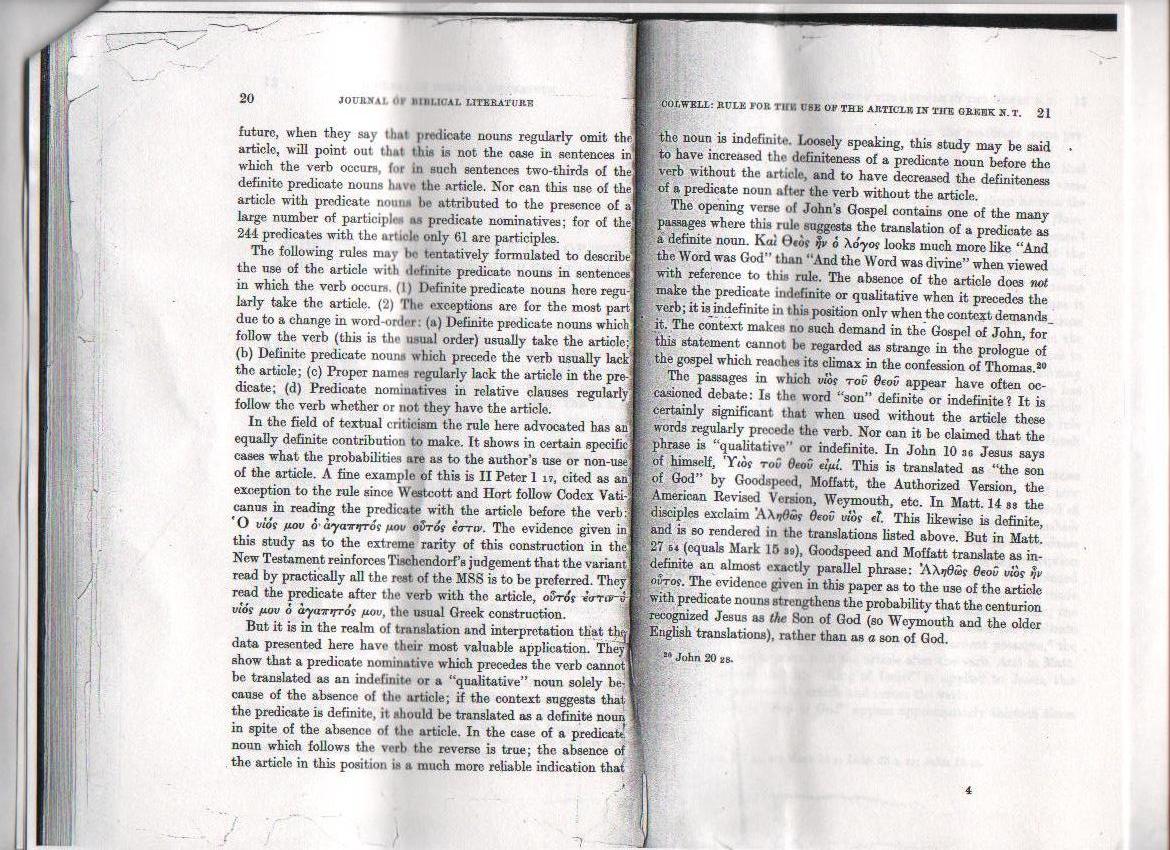
  • E.C. Colwell demonstrated that a predicate noun preceding the verb without the article is typically qualitative, not indefinite. (A Definite Rule for the Use of the Article in the Greek New Testament, pp. 20-21) (1)

  • Philip B. Harner concluded the clause means “the Word had the same nature as God.” (Qualitative Anarthrous Predicate Nouns: Mark 15:39 and John 1:1, p. 87) (2)

  • Bruce Metzger called the NWT rendering “a frightful mistranslation” (The Jehovah’s Witnesses and Jesus Christ, p. 75) (3)

  • Julius R. Mantey publicly objected to the Watchtower’s misuse of his grammar, calling their rendering “neither scholarly nor reasonable.” (Letter to the Watchtower Bible and Tract Society, Jully 11, 1974, p. 1) (4)

Even the NWT’s own Kingdom Interlinear betrays the problem: the Greek simply says the Word was God (theos ēn ho logos). (5) The grammar doesn’t allow for “a god” without importing a theology foreign to John’s prologue. But the theological implications go deeper than grammar. When this rendering of John 1:1 is combined with the Watchtower’s treatment of Hebrews — where Jesus is described as a created being, a chief angel elevated to functional godhood — the result is a system that effectively splits divinity. Jehovah becomes the supreme High God, while Jesus is a subordinate divine figure, distinct in being and eternally lesser in rank. He is worshiped, enthroned, and called “a god,” yet remains ontologically separate from Jehovah.

This framework amounts to a form of functional polytheism. It introduces two divine beings — one supreme, one subordinate — who share glory, receive worship, and rule together, yet are not one in essence. This undermines the monotheistic clarity of Scripture, which repeatedly affirms that Yahweh (Jehovah) alone is God, and that no other shares His divine nature (Isaiah 43:10; 44:6; 45:5, etc.).

By contrast, Trinitarian theology preserves monotheism by affirming that the Father, Son, and Spirit are one God in three persons — coequal, coeternal, and consubstantial. It does not elevate a creature to divinity, but recognizes that the Son is divine by nature, not by appointment.

Hebrews 1 and Psalm 102 — The Creator Identified

In Hebrews 1:10–12, the writer quotes Psalm 102:25–27 — a psalm addressed to Jehovah — and applies it directly to the Son.
If you read Psalm 102 in the NWT, the speaker is clearly addressing Jehovah from the very first verse:

“O Jehovah, hear my prayer…” (Ps. 102:1, NWT)

Through the psalm, the “you” being addressed is consistently Jehovah. In verses 25–27 (NWT), the psalmist says:

“Long ago you laid the foundations of the earth,
And the heavens are the work of your hands.
They will perish, but you will remain;
Just like a garment they will all wear out.
Just like clothing you will replace them, and they will pass away.
But you are the same, and your years will never end.”

There is no change of subject in the psalm — these words are spoken to Jehovah.

Likewise, in Hebrews 1, the writer is making a sustained argument for the supremacy of the Son over angels. However, unlike Psalm 102, which records a human speaking to Jehovah, Hebrews 1:10-12 places the words of the Psalmist into Jehovah
s mouth. Put another way, what the Psalmist says of Jehovah, Jehovah says of the Son. We see this made explicitly clear in verse 8:

“But about the Son, he (Jehovah) says…” (Heb. 1:8, NWT)

The next quotation — verses 10–12 — is introduced without changing the subject. In the NWT, it reads:

“And: ‘You, O Lord, laid the foundations of the earth in the beginning,
and the heavens are the works of your hands.
They will perish, but you will remain;
and just like a garment, they will all wear out,
and you will wrap them up just as a cloak, as a garment, and they will be changed.
But you are the same, and your years will never come to an end.’” (Heb. 1:10–12, NWT)

The “You, O Lord” here is still the Son — the same subject from verse 8 — and the words spoken by Jehovah Himself are a direct quotation of Psalm 102:25–27.

“You, O Lord, laid the foundations of the earth…”

As Thomas E. Gaston notes, this is a deliberate identification of Jesus with the God of Israel, not a casual proof-text. (Why Does Hebrews 1:10–12 Cite Psalm 102:25–27?, p. 292) (6)

The Everlasting Light — Isaiah 60 and Revelation 21

Isaiah 60:19–20 (NWT) says:

“For you the sun will no longer be a light by day, nor will the shining of the moon give you light, For Jehovah will become to you an eternal light, and your God will be your beauty. No more will your sun set, nor will your moon wane, For Jehovah will become for you an eternal light, And the days of your mourning will have ended.”

Key points to draw out:

  • The imagery is eschatological — it’s about the final, perfected state of God’s people.


  • The “eternal light” is not a metaphor for a created being; it is Jehovah Himself.


  • The text repeats the point twice for emphasis: Jehovah is the light, replacing sun and moon entirely.


  • In the NWT, “Jehovah” is explicit — there’s no ambiguity about who the Light is.

Revelation 21:22–24 (NWT) says:

“I did not see a temple in it, for Jehovah God the Almighty is its temple, also the Lamb is. And the city has no need of the sun or the moon to shine on it, for the glory of God illuminated it, and its lamp was the Lamb. And the nations will walk by means of its light…”

Key points to draw out:

  • The setting is the New Jerusalem — the same eschatological scene Isaiah described.


  • The city’s light source is the glory of God — but John immediately identifies the Lamb as the lamp of that light.


  • In the NWT, “the Lamb” is a standard title for Jesus (e.g., John 1:29, Rev 5:6).


  • The Lamb is not merely reflecting God’s light — He is the lamp through which that divine light shines to the nations.


  • In the NWT text, the Lamb is not a passive fixture; He is the means by which the light reaches the nations (“its lamp was the Lamb… the nations will walk by means of its light”). 


  • In biblical imagery, the lamp and the light are inseparable in function — the lamp is the light source in practical terms (e.g., Matthew 5:14–16).


  • The parallel with Isaiah is too exact to be accidental: both scenes describe the same eternal state, both replace sun and moon with divine light, and both identify the light with a single personal being — in Isaiah, Jehovah; in Revelation, the Lamb.

We also find additional support for this from a number of other verses in the NWT.

  • John 8:12 (NWT) — Jesus says, “I am the light of the world.” 


  • Psalm 27:1 (NWT) — “Jehovah is my light and my salvation.”


  • Revelation 22:5 (NWT) — “Jehovah God will shed light upon them” — yet in the same context, it is the Lamb’s throne (22:3).

The same role, the same glory, the same eschatological function — and in Isaiah, that role belongs to Jehovah alone. (7)

The Sanctuary of God — Ezekiel 37 and Revelation 21

Ezekiel 37:26–28 (NWT) says:

I will make a covenant of peace with them; it will be an eternal covenant with them. I will establish them and make them many and place my sanctuary among them forever. My tent will be with them, and I will be their God, and they will be my people. And the nations will have to know that I, Jehovah, am sanctifying Israel when my sanctuary is in their midst forever.

Key points to draw out:

  • The sanctuary is Jehovah’s own dwelling — not delegated to another being.


  • The promise is eternal and climactic — this is the final, perfected state of God’s people.


  • The sanctuary’s presence is the proof to the nations that Jehovah Himself is sanctifying His people.


  • In the NWT, “Jehovah” is explicit — there’s no ambiguity about who owns and occupies the sanctuary.

Revelation 21:22 (NWT) says:

“I did not see a temple in it, for Jehovah God the Almighty is its temple, also the Lamb is.”

Key points to draw out:

  • The setting is the New Jerusalem — the same eternal kingdom Ezekiel foresaw.


  • There is no physical temple because Jehovah and the Lamb together are the temple.


  • The Lamb is not a separate, lesser structure — He shares the singular role of being the temple itself.


  • The point in Ezekiel is exclusivity — no one but Jehovah is the sanctuary.


  • For the Lamb to be included in that exclusive role in Revelation means he is not a separate, lesser being, but shares in Jehovah’s own identity and presence.


  • The NWT wording doesn’t present two temples — it presents one temple, whose identity is both Jehovah and the Lamb together.

We also find additional support from additional passages in the NWT as before:

  • John 2:19–21 (NWT) — Jesus identifies His body as the temple.


  • Revelation 7:15 (NWT) — The Lamb is in the midst of the temple, shepherding his people.


  • Ezekiel 48:35 (NWT) — The city’s name will be “Jehovah Is There” — fulfilled in Revelation where the Lamb’s presence is inseparable from Jehovah’s

The Lamb shares in Jehovah’s exclusive dwelling presence — something no created being could do without blasphemy. (8)

Creator of All Things — Colossians 1:15–17

The NWT inserts “other” four times (“all other things”) to avoid the implication that Jesus created everything. But NWT’s own Kingdom Interlinear shows the Greek τὰ πάντα (ta panta)—“all things”—with no “other” present. This is the correct translation of ta panta and it is actually rendered as such in passages like Ephesians 1:10 in the NWT. (9)

As Daniel B. Wallace observes, the insertion of “other” in Colossians 1:15-17 is a doctrinally motivated, deliberate attempt to obscure the meaning of Scripture from the reader, and is inconsistent with the NWT’s own translation choices elsewhere. (Greek Grammar Beyond the Basics, p. 267) (10)

Alpha and Omega — Revelation 1 and 22

Revelation 1:8 (NWT) says:

“‘I am the Alʹpha and the O·meʹga,’ says Jehovah God, ‘the One who is and who was and who is coming, the Almighty.’

Key points to draw out:

  • In the NWT, the speaker is explicitly identified as Jehovah God.


  • “Alpha and Omega” is a title drawn from the first and last letters of the Greek alphabet — meaning “the beginning and the end,” the One who encompasses all of history and existence.


  • The verse also ties the title to the Almighty and to God’s eternal nature (“who is and who was and who is coming”).


  • This is an exclusive divine self‑designation — no created being is ever called “Alpha and Omega” in Scripture.

Revelation 22:12–16 (NWT) says in part:

“Look! I am coming quickly, and the reward I give is with me, to repay each one according to his work. I am the Alʹpha and the O·meʹga, the first and the last, the beginning and the end… ‘I, Jesus, sent my angel to bear witness to you about these things for the congregations. ...’”

Key points to draw out:

  • The speaker says, “I am coming quickly” — a phrase used throughout Revelation for Christ’s return (e.g., Rev 3:11, NWT).


  • The speaker identifies Himself as the Alpha and the Omega — the exact title Jehovah claimed in 1:8.


  • Just a few verses later, the same speaker says, “I, Jesus, sent my angel…” — directly identifying himself as Jesus.


  • The NWT leaves no room for a change of speaker between verse 13 and verse 16 — the “I” is continuous.


  • If the speaker in verse 13 is Jehovah, and in verse 16 is Jesus, then the text is presenting them as the same speaker — which is exactly the point.

Once more, we have additional corroboration from other passages in the New World Translation:

  • Revelation 2:8 (NWT) — Jesus says he is “the First and the Last, who became dead and came to life again” — another divine title from Isaiah 44:6 applied to Jehovah.


  • Isaiah 44:6 (NWT) — “I am the first and I am the last. There is no God but me.”


  • Revelation 1:17–18 (NWT) — The “First and the Last” says, “I became dead, but look! I am living forever” — clearly Jesus.

The title denotes eternal sovereignty over all history. The NWT applies it to both Jehovah and Jesus — collapsing the supposed ontological gap. (11)

The Glory Jehovah Will Not Share

Isaiah 42:8 (NWT)

“I am Jehovah. That is my name; I give my glory to no one else, nor my praise to graven images.”

Isaiah 48:11 (NWT)

“…And I will not give my glory to anyone else.”

John 17:5 (NWT)

“So now, Father, glorify me (Jesus) at your side with the glory that I had alongside you before the world was.”

Revelation 5:12–13 (NWT)

“…to the One sitting on the throne and to the Lamb be the blessing and the honor and the glory and the might forever and ever.

Key points to draw out:

  • Jehovah explicitly declares that His glory is exclusive — it is not given to any other being.


  • Jesus claims to have shared that glory before creation and asks to be glorified alongside the Father again.


  • In Revelation, the Lamb receives the same eternal glory as the One on the throne — from every creature in existence.

Once again, Scripture collapses the ontological distinction between Jehovah and the Son. Jehovah does not share His glory with another, yet He does so with the Son.

Jehovah's Angel is Jehovah in Exodus 3

Exodus 3:1–15 (NWT)

Jehovah’s angel appeared to him in a flame of fire in the midst of a thornbush. As he kept looking, why, here the thornbush was burning with the fire and yet the thornbush was not consumed.

“When Jehovah saw that he turned aside to look, God called to him out of the midst of the thornbush and said: ‘Moses! Moses!’ to which he said: ‘Here I am.’

Then he said: ‘Do not come near here. Remove your sandals from your feet, because the place where you are standing is holy ground.’

“And he went on to say: ‘I am the God of your father, the God of Abraham, the God of Isaac, and the God of Jacob.’ Then Moses hid his face, because he was afraid to look at the true God.

Jehovah added:I have certainly seen the affliction of my people who are in Egypt, and I have heard their outcry because of their oppressors, for I well know the pains they suffer.

I will go down to rescue them out of the hand of the Egyptians and to bring them up out of that land to a good and spacious land, a land flowing with milk and honey…’

“At this God said to Moses: ‘I Will Become What I Choose to Become.’ And he added: ‘This is what you are to say to the Israelites, ‘I Will Become has sent me to you.’

“Then God said once more to Moses: ‘This is what you are to say to the Israelites, ‘Jehovah, the God of your forefathers, the God of Abraham, the God of Isaac, and the God of Jacob, has sent me to you.’ This is my name forever, and this is how I am to be remembered from generation to generation.’”

So, here in Exodus, we clearly see in the NWT that Jehovah’s angel is identified with and speaks as Jehovah Himself. This is not something we would see if this person were a lesser created being.

Key points to draw out:

  • Verse 2 — “Jehovah’s angel appeared to him (Moses) in a flame of fire in the midst of a thornbush.”


  • Verse  4 — “When Jehovah saw that he (Moses) turned aside to look, God (i.e., Jehovah) called to him out of the midst of the thornbush…”


  • Verse  6 — The voice speaking from within the burning bush declares: “I am the God of your father, the God of Abraham, the God of Isaac, and the God of Jacob.”


  • Verses 7–15 — The speaker continues as Jehovah and God, commissioning Moses and revealing the divine name (rendered “I Will Become What I chose to Become in the NWT or “I Am” in most other translations I Am” being a title Jesus used of himself on numerous occasions, e.g., John 8:24, 28, 58; 13:19, 18:5-6; Mark 14:61-62, etc.). 

The Angel of God and Jehovah’s Presence in Exodus 13–14

Exodus 13:21–22; 14:19–20

Jehovah was going ahead of them by day in a pillar of cloud to lead them along the way, and by night in a pillar of fire to give them light, so that they could travel by day and by night. The pillar of cloud by day and the pillar of fire by night never left its place in front of the people.”


“Then the angel of the true God who was going ahead of the camp of Israel departed and went to their rear, and the pillar of cloud moved from in front of them and stood behind them. So it came between the camp of the Egyptians and the camp of Israel. On the one side it was a cloud and darkness; on the other side it was lighting up the night. So the one camp did not come near the other all night long.”


Here, as in Exodus 3, the narrative presents a striking overlap between Jehovah Himself and His angel. In 13:21, it is Jehovah who is personally going ahead of Israel in the pillar of cloud and fire. Yet in 14:19, the one moving is “the angel of the true God” — and the pillar moves with him. The text does not treat these as two separate presences; rather, the angel’s movement and Jehovah’s movement are described as one coordinated act.


This is consistent with other “blended identity” passages where the malʾakh YHWH (angel of Jehovah) is both distinct from and yet fully identified with God, speaking and acting as His very presence.

Key points to draw out:


  • Exodus 13:21 — “Jehovah was going ahead of them… in a pillar of cloud… and… in a pillar of fire.” The divine presence is explicitly attributed to Jehovah Himself.


  • Exodus 14:19a — “The angel of the true God… departed and went to their rear.” Here the guiding presence is described as God’s angel — yet his movement is inseparable from the movement of the pillar in which Jehovah was said to be present.


  • Exodus 14:19b — “The pillar of cloud moved from in front of them and stood behind them.” The pillar’s movement is narrated in parallel with the angel’s movement, reinforcing that the angel is the personal manifestation of God’s presence.


  • Exodus 14:20 — The pillar/angel stands between Israel and Egypt, simultaneously bringing darkness to one side and light to the other — a supernatural act of protection and guidance attributed elsewhere directly to Jehovah.


Just as in the other passages we’ve discussed, the line between Jehovah and His angel is intentionally blurred. The angel is not portrayed as a mere created messenger operating independently, but as the embodiment of Jehovah’s own presence — guiding, protecting, and delivering His people. The narrative’s seamless shift between “Jehovah” and “the angel of the true God” underscores the theological reality that to encounter this angel is to encounter Jehovah Himself.

Misunderstanding “Angel”: A Linguistic Clarification

Jehovah’s Witnesses often assume that the word “angel” refers exclusively to supernatural beings. But in the Old Testament, the Hebrew word translated “angel” is מַלְאָך (malak) — meaning simply “messenger.” It is a job description, not a category of created beings. In fact, the exact same word is frequently used to describe human beings (e.g., 2 Samuel 5:11; Malachi 2:7; Haggai 1:13, etc.). The context determines whether the messenger is human or divine — not the word itself. Additionally, the presence of the definite article (“the malak of Jehovah”) often signals a unique, divine figure — not a generic angelic being.

This linguistic nuance is crucial. The NWT’s rigid interpretation of “angel” as a lower ontological category of divine beings exclusively leads to theological error. The Angel of Jehovah is not merely a messenger from God — he is consistently identified by Scripture as God’s own self-revelation, speaking, acting, and receiving worship as Jehovah.

The Angel of Jehovah: Seen, Worshiped, and Named as God

Judges 13: A Theophany in Disguise

In Judges 13:1–23, the New World Translation recounts the story of Samson’s parents encountering “Jehovah’s angel.” The passage builds toward a climactic theological moment, especially in verses 13–22:

“So Jehovah’s angel said to Ma·noʹah: ‘Your wife should keep herself from everything that I mentioned to her. She should not eat anything that the grapevine produces, she should not drink wine or anything alcoholic, and she should not eat anything unclean. Everything that I commanded her, let her observe.’

“Ma·noʹah now said to Jehovah’s angel: ‘Please stay, and let us prepare a young goat for you.’

“But Jehovah’s angel said to Ma·noʹah: ‘If I stay, I will not eat your food; but if you wish to present a burnt offering to Jehovah, you may offer it up.’ (Ma·noʹah did not know that he was Jehovah’s angel.)

“Then Ma·noʹah said to Jehovah’s angel: ‘What is your name, so that we may honor you when your words come true?’

“However, Jehovah’s angel said to him: ‘Why do you ask about my name, when it is a wonderful one?’

“So Ma·noʹah took the young goat and the grain offering and offered it on the rock to Jehovah. And He was doing something amazing while Ma·noʹah and his wife were watching.

“When the flame ascended from the altar toward the heavens, Jehovah’s angel ascended in the flame of the altar while Ma·noʹah and his wife were watching, and they immediately fell with their faces to the ground.

“Jehovah’s angel did not appear again to Ma·noʹah and his wife. Then Ma·noʹah realized that it had been Jehovah’s angel. Ma·noʹah then said to his wife: ‘We will surely die, because it is God we have seen.’”

Key points to draw out:

  • Verse 13 (NWT): “So Jehovah’s angel said to Ma·noʹah: ‘Your wife should keep herself from everything that I mentioned to her.’”


  • Verse 16: “Ma·noʹah did not know that he was Jehovah’s angel.”


  • Verse 18: “Why are you asking about my name, seeing that it is a wonderful one?”


  • Verse 20: “Jehovah’s angel ascended in the flame from the altar while Ma·noʹah and his wife were looking on. At once they fell with their faces to the ground.”


  • Verse 22: “Ma·noʹah then said to his wife: ‘We are sure to die, because it is God whom we have seen.’” (12)

Despite the NWT’s attempt to distinguish “Jehovah’s angel” from Jehovah Himself, the narrative collapses that distinction. Manoah’s conclusion is unmistakable: they have seen God–capitol G. Not merely “a god” as in the NWT version of John 1:1. Nor was this a created messenger. It was God. This echoes Judges 6:11–24, where Jehovah's angel is unmistakably identified as Jehovah Himself (verses 14–16). The encounter leaves Gideon terrified, crying out, “Alas, Sovereign Lord Jehovah! I have seen Jehovah’s angel face-to-face!” — a reaction reserved for those who realize they’ve stood in the presence of God.

Worship and Divine Identity

Throughout the Hebrew Bible, the Angel of Jehovah:

  • Speaks as God (Genesis 22:11–12, 31:11-13; Exodus 3:2–6)


  • Receives worship (Joshua 5:14–15; Judges 13:20)


  • Forgives sins (Exodus 23:21)


  • Bears the divine name (Exodus 23:21: “My name is in him”)

These are not attributes of a created being. As Edward Dalcour notes, “The angel of the Lord in the OT was not a mere ‘created’ angel… He was identified as, and claimed to be, YHWH.” (The Preincarnate Christ as the “Angel of the LORD” (YHWH), para. 2) (13)

Jehovah Commands His Angels to Worship the Son in Hebrews 1:6

“But when he again brings his Firstborn into the inhabited earth, he says: ‘And let all God’s angels do obeisance to him.’”

The Greek verb προσκυνέω (proskyneō) is consistently translated as “worship” in the NWT when directed toward Jehovah (e.g., John 4:24) or even false gods (e.g., Revelation 9:20). Yet whenever this word is applied to Jesus, as in Hebrews 1:6, the NWT shifts to “do obeisance” — a deliberate softening that obscures the divine honor being commanded. This selective rendering reflects theological bias rather than lexical necessity, especially given that all God’s angels are instructed to respond this way to the Son.

The Angel as the Pre-Incarnate Son

The Angel of the Lord (Jehovah's angel) is widely regarded by scholars and church fathers as a pre-incarnate appearance of Christ:

  • Justin Martyr identified the Angel of the Lord as the Logos.


  • Irenaeus called Him “the Word of God” appearing to Moses.


  • Athanasius argued that the Angel was categorically distinct from created angels.


  • Modern scholars like Jonathan McLatchie and Taylor Marshall affirm this identification as consistent with Trinitarian theology. (14, 15)

“The Voice in the Wilderness” — Isaiah’s Prophecy and Its Fulfilment in Jesus


Isaiah 40:3–5, 9–11 (NWT)

“A voice of one calling out in the wilderness: ‘Clear up the way of Jehovah! Make a straight highway through the desert for our God. Let every valley be raised up, And every mountain and hill be made low. The rough ground must become level, And the rugged ground a valley plain. The glory of Jehovah will be revealed, And all flesh will see it together, For the mouth of Jehovah has spoken.’ 

“Go up onto a high mountain, You woman bringing good news for Zion. Raise your voice with power, You woman bringing good news for Jerusalem. Raise it, do not be afraid. Announce to the cities of Judah: ‘Here is your God.’ Look! The Sovereign Lord Jehovah will come with power, and his arm will rule for him. Look! His reward is with him, and the wage he pays is before him. Like a shepherd he will care for his flock. With his arm he will gather together the lambs, and in his bosom he will carry them. He will gently lead those nursing their young.”


Gospel Fulfilment:


  • Matthew 3:1–3 — John the Baptist is introduced as “the one spoken of through Isaiah the prophet”, preparing the way for the Lord.


  • Mark 1:2–4 — Mark combines Malachi 3:1 and Isaiah 40:3, applying them to John’s ministry before Jesus’ arrival. In the NWT, the link to Isaiah 40 is unmistakable: “A voice of one crying out in the wilderness: ‘Prepare the way of Jehovah! Make his roads straight.’” In context, the one whose way John prepared is none other than Jehovah Himself — and in the very next verses, the Gospels present that One as Jesus, making the identification inescapable


  • Luke 3:2–6 — Luke quotes Isaiah 40:3–5 more fully, linking John’s call to repentance with the prophecy that “all flesh will see the salvation of God.”


  • John 1:23 — John the Baptist identifies himself directly: “I am a voice of someone crying out in the wilderness, ‘Make the way of Jehovah straight,’ just as Isaiah the prophet said.” (NWT)


  • John 10:1-21 — Jesus here identifies himself as “the good shepherd”, alluding back to what Jehovah said of himself in places like Isaiah 40:11 and Ezekiel 34:11-16.


Theological Significance:


  • In Isaiah’s original context, the “voice” prepares the way for Jehovah Himself to come to His people in power and shepherd‑like care.


  • The Gospel writers apply this to Jesus, implying that his arrival is the arrival of the very presence and salvation of God foretold by Isaiah.


  • The NWT’s retention of the divine name “Jehovah” in both Isaiah and John 1:23 makes the identification especially clear: the one whose way John prepared is the one Isaiah said was Jehovah coming to His people. And John the Baptist himself identifies that person as Jesus in John 1:29-34.

Signs that Confirm Jesus’ Identity: The One Who Opens Blind Eyes

Psalm 146:8 (NWT)

Jehovah is opening the eyes of the blind; Jehovah is raising up those who are bowed down; Jehovah loves the righteous.”

Isaiah 35:4–5 (NWT)

“‘Look! Your own God will comeHe will come and save you.’ At that time the eyes of the blind will be opened, and the ears of the deaf will be unstopped.”

Isaiah 42:6–7 (NWT)

“…I have appointed you… for you to open the blind eyes, to bring the prisoner out of the dungeon…”

John 9:1–7, 32–33 (NWT)

“…From of old it has never been heard that anyone opened the eyes of one born blind. If this man were not from God, he could do nothing.”

Matthew 11:4–5 (NWT)

“…the blind are now seeing, the lame are walking, the lepers are being cleansed, the deaf are hearing, the dead are being raised up…”

Key points to draw out:

  • In the OT, opening the eyes of the blind is a direct work of Jehovah — tied to His coming to save His people.


  • No prophet in the OT is recorded as healing physical blindness; it is a divine act.


  • In the NT, Jesus repeatedly heals the blind — including a man born blind, something “never heard” before.


  • Jesus presents these miracles as proof of his messianic identity, fulfilling Isaiah’s prophecies of God Himself coming to save.

Scripture says that Jehovah alone opens the eyes of the blind (Psalm 146:8; Isaiah 35:4–5). Jesus opens the eyes of the blind in ways never before seen (John 9:32). If Jehovah alone does this, and Jesus does it, then, once again, Jesus shares Jehovah’s identity.

Conclusion: When Scripture Overpowers the Translator

The Watchtower has labored for decades to produce a Bible that conforms to its theology. Yet the Word of God is stubborn. Even in the pages of the New World Translation, the divine identity of Jesus refuses to be edited out. His titles are the titles of Jehovah. His actions are the works of Jehovah. His worship is the worship due only to Jehovah. His attributes are the eternal attributes of Jehovah.

For the reader willing to trace the cross‑references, the pattern emerges with unmistakable clarity: the Jesus of the New Testament is not “a god” among many, nor a created archangel wearing borrowed glory, but the eternal Word — the One who was with God in the beginning, and who both was and still is God.

This is not a conclusion reached by clever argument alone; it is the testimony of Scripture itself, even in a translation designed to deny it. And that leaves us with a question no footnote, bracket, or re‑rendering can erase: if Jesus truly shares the identity of Jehovah, then the only faithful response is not to diminish Him, but to bow before Him — to honor the Son just as we honor the Father, as the Scriptures command. Anything less is not reverence, but rebellion.